They don't believe in helmets in Kauai, even in caves. "They're too hot". Fortunately Jamie and I both brought our own, and find them reasonably comfortable. They were suspicious when we only wanted one PFD (life vest), and wanted to push another one of those on me. I pointed to my carrysack in the passenger seat and said "I brought my own, would you like to see it", and then they relaxed and didn't actually require I show it to them. They saw the child seat in the back of the rental car (for Jamie's 6 month old baby), and I saw alarm bells going off in their heads again. I assured them: "No we aren't taking the baby in the kayaks, on the ocean or off", and they relaxed again. They also don't believe in paddle leashes in Kauai, so I made my own out of three meters of parachute cord from my emergency kit. By the time I got back to Moloaa Bay it was early afternoon so we went on a short trip to try out the kayaks.
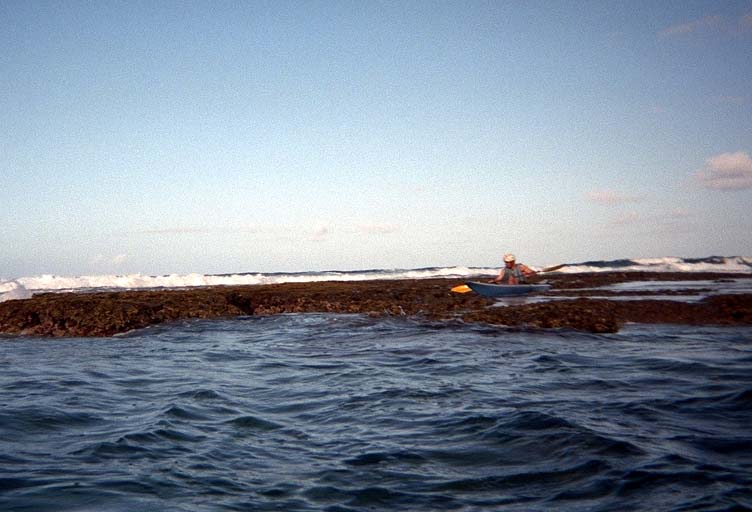
We paddled north around the point and down the edge of a corral reef. Jamie had read about dealing with these reefs but neither of us had any real experience yet. The theory is this: As the waves break over the reef they pump water into the calm area close to shore. This excess water has to get out somewhere, and it usually carves deep channels through the reef over time. These are called rip currents and there are signs all over the island warning swimmers to look out for them. In a kayak, however, these rip currents are deeper channels where the waves don't break over the reef and you can paddle into the safe harbor close to shore. As we paddled down the outer edge of the reef in front of Sanders Beach, we came upon an area where the water rose up in little noisy standing waves. A classic rip current! We followed this current in at an angle, through a sharp turn, and finally behind the reef.
As we were looking into this channel, I saw the head of an animal rise up out of the water for a few seconds. It was too small for a seal and kind of square. This turned out to be a sea turtle! For the rest of the day, and on almost every trip, I saw sea turtles in the water everywhere I went. They usually saw me before I got very close and dove away. Occasionally I got almost close to touch one and a few times I tried to photograph one as it swam away.
Paddling behind the reef was interesting. The waves rose up and broke over the outer edge of the reef, then lost almost all their energy before they got inside. After a while we ran into water that was too shallow for the boats. Pulling the boats behind us we started detecting a strong current going the same direction we were. Jamie said this current would lead us to the next rip current and our exit from the reef. This worked great and we soon found a place where we could exit out to sea. But the reef was still a new experience so we turned back in and went behind it again. Jamie stopped half way in and sat there for a long time, reveling in being close to the breaking waves. When he came in he suggested I try it. Soon after I got into the channel, a large set of waves came it. I braced into one and was surfed sideways all the way behind the reef again!
We stayed behind the reef until we could not proceed past rocky Kepuhi Point without exiting out to sea again. Then we turned back and retraced our steps. Jamie thought we had passed the first rip current we came in through, but followed my lead. I went straight to it and correctly navigated the crooked channel out to sea, then around the corner and back to our bungalow on the beach. Six kilometers of kayaking on the round trip.