We got up early to take down the tent and pack everything away out of sight. A helicopter flew by in the morning and Jamie hid from it. I didn't hide, saying that I wasn't going to act guilty. If they stopped by I was going to say we stopped here on a day trip, since they didn't actually see our tent. The helicopter was a uniform gray color, not the Coast Guard red and white. There is a military base south of Milolii and we saw a bunch of other gray Navy looking airplanes head in that direction. Probably no reason to hide our stuff from them
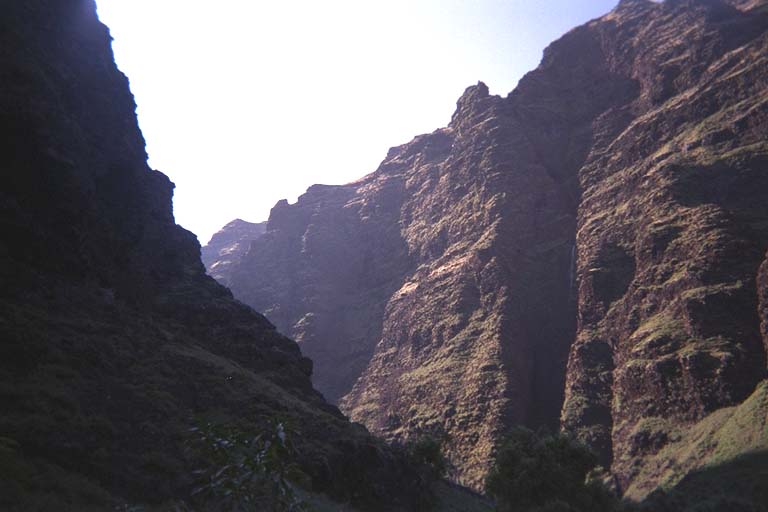
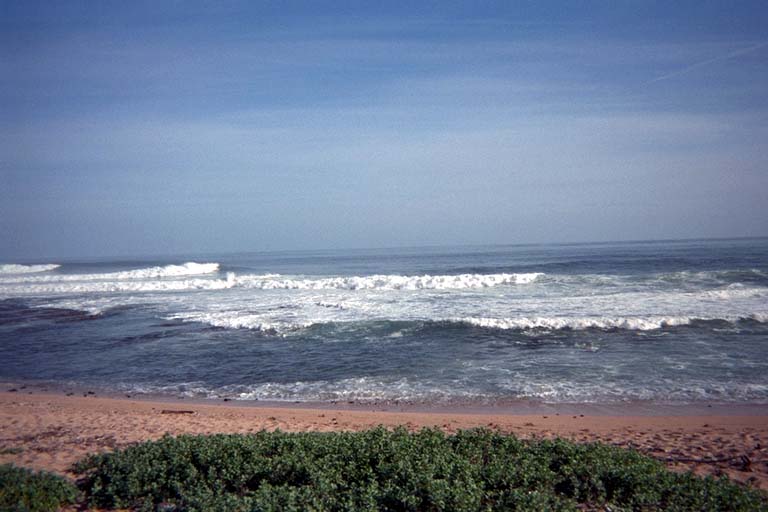
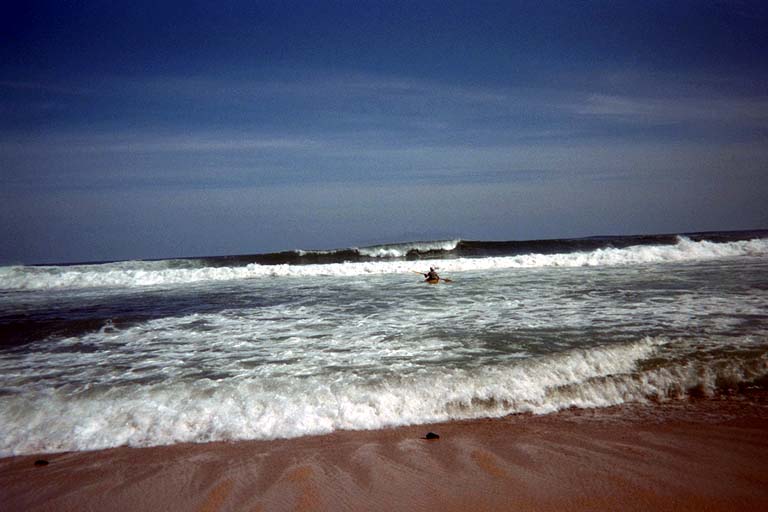
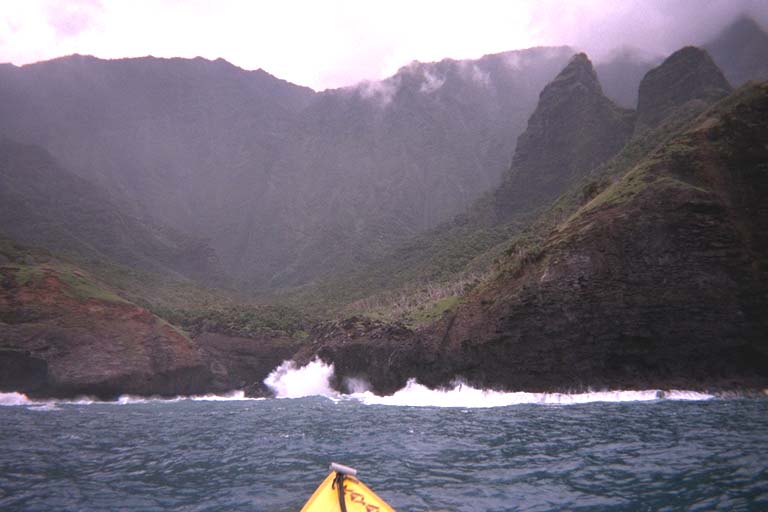
Before launching, we went for a walk up the valley but not far enough to get to the waterfall. We climbed up the side of the valley at one point for the view, and met a goat up on the side the cliff. After that we saw a few more goats on the cliffs and could hear a lot more of them bleating back and forth across the valley. Jamie didn't think the valley would get any different and I was anxious about the swells so we turned back. Milolii Beach sits under a tall cliff and the weather radio could not hear the report this morning. The swells looked a lot rougher but the channel was often passable. I tried to take a picture of the channel while it was rough, but it perversely calmed down while the camera was out. Later when we are ready to launch, the waves do not look so calm. Next time I'll try pointing the camera at them to calm them.
Jamie's timing had been excellent all week, so when he launched out the channel I started out a few waves behind him (far enough to not get smacked by his kayak if he gets in trouble). Huge waves were breaking over the reef from the northwest. Unfortunately, these waves created breakers that often crossed diagonally across the channel. We keep getting pushed to the right, possibly out of the channel and over the coral reef. A large set came in and we had to plow over the breakers from them. Jamie made it over one large breaker, and then it hit me. I held the paddle low and to the right, managed to brace and keep the kayak facing through the breaker. The water cleared in front of me and I started thinking I had made it safely when the kayak stalled on top of the breaker and started to surf backwards. The kayak rotated until it was broadside to the wave and surfing towards shore. I switched back and forth bracing on one side and the other and managed to stay in the kayak and keep it upright. This gave me a moment of self pride, then I realized I was surfing towards the coral reef on the east side of the channel. Rather than get surfed into this, I bailed out of the kayak. I held onto the paddle for a while, but the wave was towing me towards the coral by it, so I let it go as well. My plan was to swim back into the channel and get to shore that way. Unfortunately, the next few waves had other plans and they dragged me across the reef.
The worst part of this rough landing on the reef was getting left high and dry by one wave. Standing up in ankle deep water I had to turn and face a wall of water rushing at me. I tried leaping up into the air to make the water carry me over the rest of the reef. But there wasn't enough water to hold me up and I ended up falling down and getting dragged across the rough coral. Next time this happens I'm going to try staying in the kayak and surfing all the way across the reef. The white water had shucked my toes out of my Teva-style sandals again. Even Jamie, who did not hit the reef, had his Teva sandals shucked half way of and took them off and stowed them. We both agreed later that this type of sandal is worse than useless in rough water and something else must be found. I had to sit on the reef through one wave while I pulled them back on before I could even crawl the last 20 meters to the sandy beach.
When I scrambled out of the water on the beach, I had a bruise on my right knee, scratches across the tops of all my toes and hands, blood oozing through the elbow of my dive suit, and a very painful bruise on my left thigh. This bruise grew fangs during the day and got more painful. Underneath the dive suit later I found a large ugly scrape on top of the bruise. The lycra dive suit was not damaged at all despite the damage underneath. I shudder to think how cut up I would have been without it.
Jamie was knocked over and swam his kayak to shore down the channel soon after I made to the beach. He had to try two more times before he made it out the channel. On my next attempt, I sat in the soup of the channel for a while, plowing over the breakers when they had lost a lot of energy close to shore. After a while I saw a calm window in the waves and easily paddled out to sea. When I caught up with Jamie, he commented: "We should not have let bureaucrats decide when it was safe for us to paddle". If we had violated our camping permit several days ago, we would not have had such a rough launch. I turned on the weather radio and listened to the report: Sixteen foot swells at buoy number one. The roughest seas that either of us have ever been on.
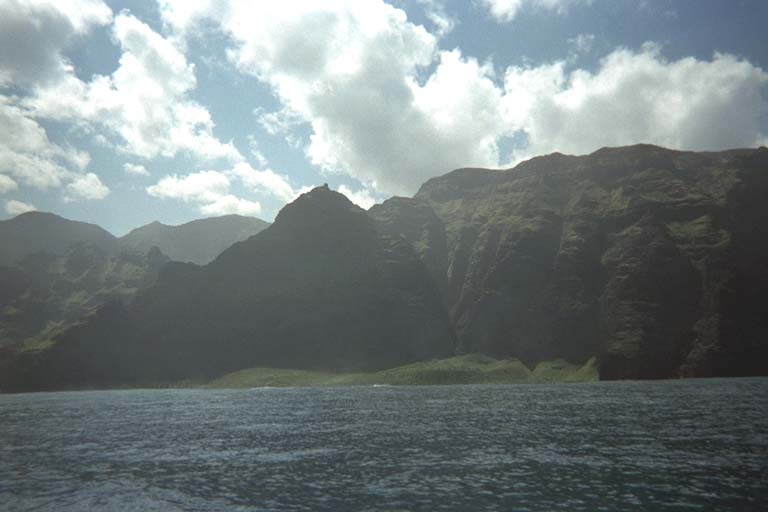
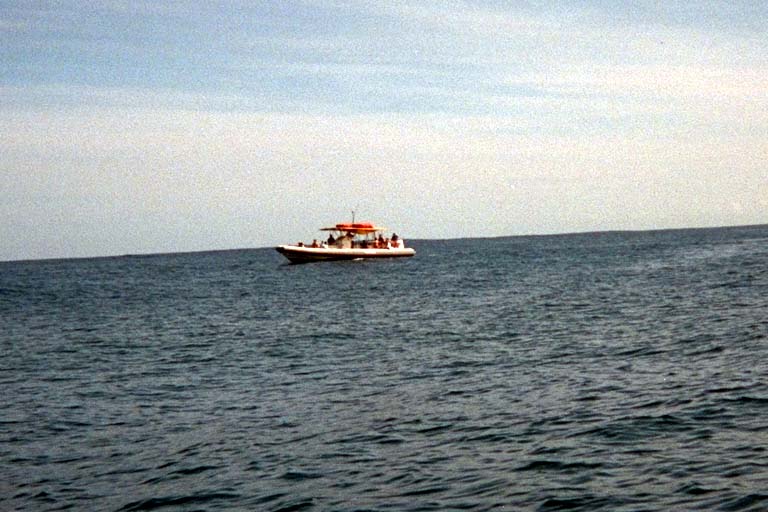
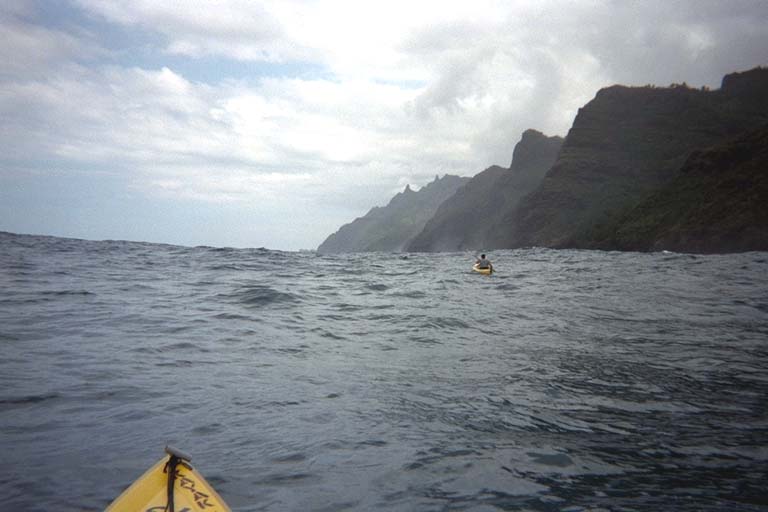
On the trip back we stayed a kilometer away from shore. We had originally hoped to go back up the coast and land at a few interesting places, including the Kalalau Beach Campground to see what it was like. But neither of us wanted to go through another rough launch like that. We passed a few zodiac-type touring boats and they all turned to come and talk to us. They were surprised to see us out on this day, and everyone told us that we would not be able to make a landing at Kee Beach. They recommended that we continue on to Hanalei Bay. One of these zodiacs was "the largest tubes ever made by Zodiac", a 43 foot long boat. The captain says that even his boat regularly goes into the caves, including the open-ceiling cave. Jamie and I were amazed to hear that such a large motor boat could fit in there. When another zodiac approached us from closer to shore, I smiled and joked to the captain: "How are the caves today?" He was not amused.
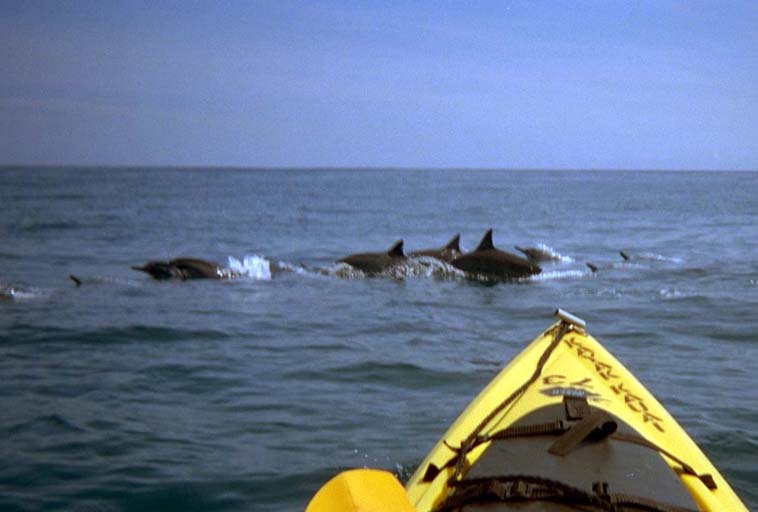
I turned on the scanner of my marine radio as we traveled, and finally heard it used by two of the tour boats. Just like you are supposed to use them, one boat hailed the other on channel 16, then they agreed to switch to another channel. Without having to let go of my paddle, the scanner on my radio switched to the other channel when it became active. This hands free operation is an advantage I don't have at home, where the marine channels are so busy you end up listening to the wrong continuing conversation. One boat captain asked the other if they had seen any wildlife, and got an enthusiastic yes! There was a pod of dolphins, "spinners" off of some point I didn't recognize the name of. I could see a boat way ahead of me and hoped that this was the one that saw dolphins. I hoped we would be able to see them soon ourselves. As we got close to this boat I kept my eyes pealed on the water and did eventually see the pod of dolphins. They were heading west and out to sea, with a tour boat following them. We were able to intercept their course and soon found them rising up all around us. These "spinner" dolphins often jump up out of the water spinning around their long axis or flipping end-over-end. Another zodiac roared up to give its load of tourists a view. Jamie followed the pod for a kilometer out to sea, while I stopped paddling as soon as they came up around me. I wanted to let them swim away in peace.
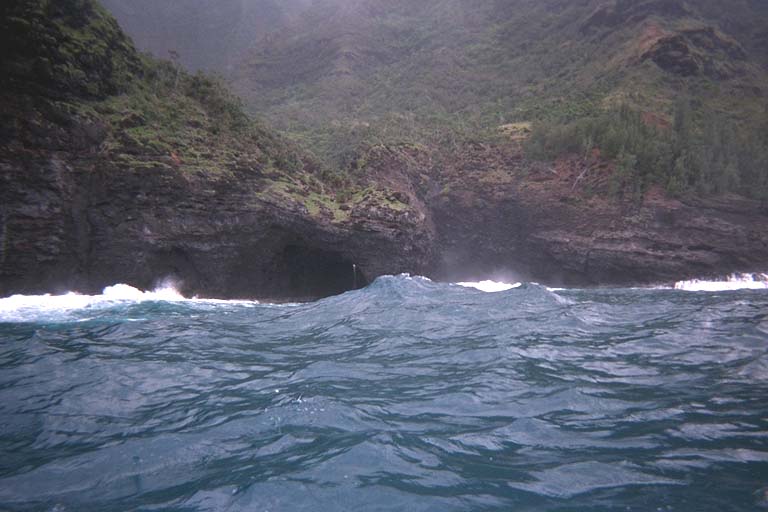
When not stopping for dolphins or caves, Jamie usually pulled way ahead of me as we paddled. As we came back to the caves, Jamie pulled very far ahead and then turned close to shore. I was afraid he wanted to try out the caves, but when I caught up to him he said he only wanted to see what they looked like today. From kilometers away we could see huge blasts of white water jetting up from the cliffs in this area. The water was very choppy in front of the caves. I found it a little frightening: The choppy water was not enough to tip me over, but I felt like I was right on the edge. If the swells got any higher even the chop might become dangerous. I turned and headed out to sea again, aiming for some very large breaking waves I could see far from shore past Kee Beach. But Jamie pulled ahead again and went close to shore to look at the landing possibilities. It was impossible to land at Kee Beach. Jamie says he has read about this problem: Being safe at sea but unable to find a safe place to land. But he didn't expect it to happen in Kauai after all the calm weather we had the previous five days. We had to turn straight out to sea to go around the Tunnels Reef and continue on to Hanalei Harbor.
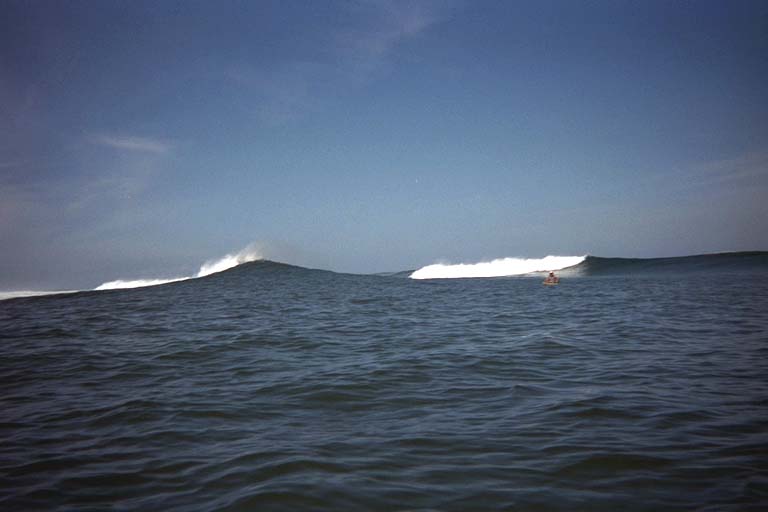
Tunnels Reef extends far out to sea and I had paddled almost a kilometer from shore to go around it a few days before. But apparently this reef extends farther out under the water. The sixteen foot swells were rising up and breaking almost two kilometers from shore. We paddled as close to shore as we dared between sixteen foot mountains of water. Occasionally a larger set would come by and a wave would tower up to twenty feet. The sides of these swells would look impossibly steep, and we would start to fear that one would break on us. The zodiac captains call these waves "dump trucks". The top of one of these tall waves would start to ripple in the wind, making noise like it was going to break. Jamie and I would both turn and paddle away from shore like mad, over the top and back down into the valley on the other side. The waves all actually broke a safe distance past us, but one close call like this after another made us paddle two kilometers from shore. I listened to the weather radio, and the swells at the buoy northwest of us slowly calmed down. From sixteen to fifteen feet, then as low as thirteen feet by the time we made our landing.
We could tell where the coral reefs were from kilometers away because the waves breaking over them blew up huge columns of mist. Especially around Tunnels Reef we had trouble seeing the shore through this mist and it occurred to me that there was one more thing that could go wrong with this trip: We could get socked in by fog and have trouble finding Hanalei Bay or finding the shore at all. Is this really just mist that will clear when we pass the big reef, or is it the start of a thicker fog? Just in case, I pulled the compass out of my emergency kit and sighted a course to Princeville on the other side of the bay. If the reef mist turned into a blinding fog, I would still be able to get to the harbor. My compass is on the back of a whistle that conveniently stands upright between my legs. It then occurred to me that it could easily slip out and get lost .... if we got socked in, and if it slipped away. I can make this a little safer in the future by putting a line on this compass so I can attach it to the kayak. Fortunately none of this was necessary and the mist stayed a local phenomenon.
We paddled past Kee Beach, where Jana was supposed to pick us up. Because we had originally planned on stopping and enjoying the shore on our way, we came past this beach hours before our scheduled meeting time. I had left the other marine radio with Jana and tried calling her every half hour. But while we were close to the beach, she was not there yet. When she arrived later and turned the radio on, we were well past Kee Beach and the tall waves in the Tunnels Reef cut her off from my horizon. She never heard us calling once.
Once we were past Tunnels Reef, the water calmed down quite a bit. Jamie looked on the chart and thought that Kolokolo Point where the Lumahai River emptied into the ocean would be a good place to land. We paddled close to shore here and looked at the river. The waves were still very rough into the mouth of the river even with a protecting point. Jamie wanted to go for it. He felt that Hanalei would be very rough because the large swell was coming from the northwest and straight into the mouth of the bay. He was afraid the harbor would be rough and joked that we would end up paddling all the way around the island. I had been in the bay a few days ago and felt that the large reef on the Princeville side would create some shelter even under the current conditions. We had also been told by several zodiac captains that Hanalei was our only chance. All the advice I had gotten from local kayakers and boaters had been good so far, and I didn't want to deviate from it. So I talked Jamie into paddling three more kilometers into the bay.
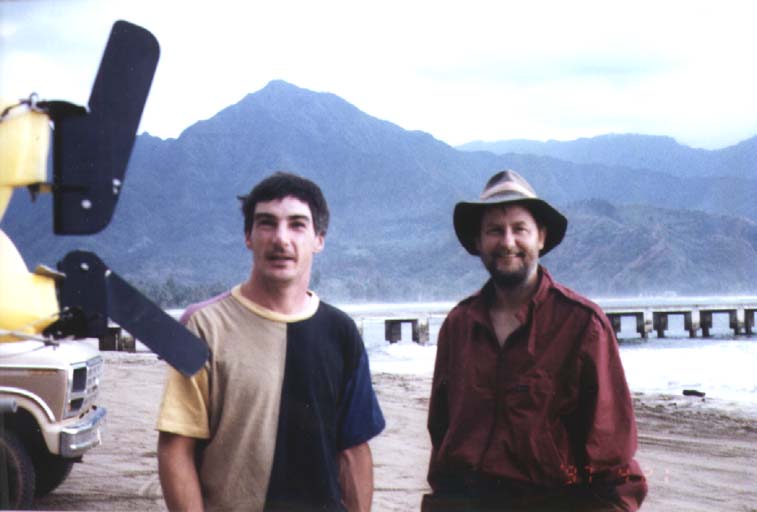
When we got into Hanalei Bay, it was full of surfers. All week we had been padding in smooth water with mild swells. The surfers had all been praying for big swells while we prayed for the calm water to continue. The surfers were happy now. Where the waves broke over and around the coral reef on the east side of the bay, there were a hundred surfers sitting in the water waiting their turns. One at a time we saw them catch the waves along the edge of the reef, surf for several hundred meters, then turn out into the harbor to paddle back for another ride. Jamie turned and paddled closer to watch them for a while. He says you can learn a lot of useful techniques for surfing your kayak by watching real surfers. We paddled around the end of the reef and landed in the mild waves on the Black Pot City Beach Park. Safe on dry land at last. Then Jamie hitch-hiked back to Kee Beach and drove back with Jana (who was starting to get very worried) to pick up the equipment.