Every year, BASK does several large group kayak camping trips. I’m trying to establish a Russian River trip as an annual event in the spring and the Mendocino Campout in the fall is well established. New Years Eve on Angel Island is another of these annual trips, and I went to the one last year and had a great time, despite the drizzly wet weather. Barbara Kossy was organizing the trip this year but she was going to be out of town and convinced Maryly Snow to take over collecting the list of people coming and organizing them for the pot luck. This turned out to mean that I had to do all the organizing about the put-in and timing the trip to the tides in the San Francisco Bay. I spent entirely too much time pawing through the S.F. Bay Currents charts in the back of the TideLog and figuring out what time we would have to leave from various places. There was a strong ebb current (5.7 knots) predicted for the afternoon, so if you picked the wrong location at the wrong time you could get swept out to the Faralon Islands by mistake! Eventually people paddled from all over the bay, leaving from Horseshoe Cove (Fort Baker) in the morning during the flood tide, paddling across from Sausalito during the slack, or down from San Quentin during the peak of the ebb tide current.
Because I wanted to stay up until after midnight on New Years Eve, I didn’t want to ride the flood tide in the morning then have to amuse myself all day and all night. I wanted to launch from San Quentin with just enough time to set up a tent and start cooking dinner. Maryly was worried that this meant paddling 10 kilometers instead of the 5 kilometers from Horseshoe cove. I convinced her that having a 2.9 knot current in our favor would make this the easiest 10 kilometers she would ever paddle. This turned out to be correct.
But on the way we had some excitement. I mentioned that it was interesting to paddle close to the pylons for the ferry channel markers and watch how fast the water rushed past them. I also predicted that the current would probably pull us too far south to go around or near the last of these markers. One kayaker, Gordon, seemed to take this as a challenge and made an extra effort to go around behind the marker, then crashed into it. He says that he was mesmerized by the spectacular view of the Berkeley and Richmond hills with Mt. Diablo disappearing into the clouds behind them. The current pulled him sideways then pinned him against the barnacle covered concrete pylon. He tipped over into the marker, his paddle broke and he let the current hold him there while he tried to get us organized to catch the pieces for him. Then his spray skirt popped open and his shoes and water bottle drifted out. We finally got him to push off and swing his boat around, which flipped over and dumped him out. I was relieved at this point because I imagined that the current was strong enough to pin him against the pylon with his head underwater. At least swimming in the bay he was safe from that. With lots of helpers to raft up around his boat we soon had him back in and pumping out all the water. He did not have a spare paddle, but several other people (including I who learned this lesson a long time ago) had a spare we could loan him.
Without further incident we paddled the rest of the way to Angel Island, only stopping to try to get our kayaks stuck in the whirlpools in the eddy lines in Raccoon Strait. We landed to find several other groups already setting up camp, the people who launched in the flood and slack tides. On the West side of Angel Island there is a flat spot 30 meters above the waterline that the rangers call the "Kayak Camp". They will let up to 16 people camp there. We had over 30 people interested in going on this camping trip, so Maryly reserved two other "Ridge Camps" that were 80 meters above the water and 800 meters farther west. Five other people loosely affiliated with BASK rented Ridge Camp number 4 and joined us for the meals. Although the campgrounds are not well used on this State Park Island in winter, we still managed to reserve most of the island for ourselves. Of course a bunch of people didn’t show up and we probably could have all fit into Kayak Camp. The view from Ridge Camp Number Five was spectacular, however, so we decided to have all our meals up there. Maryly, one other kayaker named Rob Nevitt, and I hauled our camping gear up to Ridge Camp Number 3 and set up our tents there. I had stayed in Kayak Camp the year before and now I think the Ridge Camps are far superior. The ground is dryer and they get the morning sun much sooner than the Kayak Camp. I think it is worth the extra climb with the equipment.
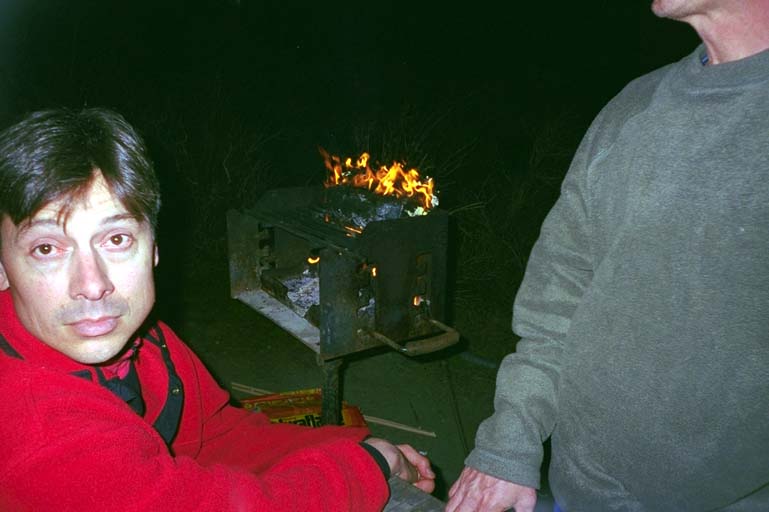
Between campsite numbers 3 and 5 was a large concrete bunker buried in the hill with sloping walls, terraces, ladders and courtyards. "WALLACE" was printed over one of the doors and this structure once held a large gun for guarding the entrance to San Francisco Bay. There is the remains of a "dumb waiter" for bringing rounds up from the buried rooms. Unlike many of the bunkers at the mouth of The Bay in the GGNRA, this one is not barred and chained shut and you can explore all the rooms with a flashlight. The gun is long gone but a circular hole remains in the concrete where it was once bolted in place. This would make a nice place for a campfire if wood logs were not forbidden in the park. Only Duraflame type fake logs are allowed in the fire boxes provided. We brought a bunch of Duraflames and kept one burning all evening. The manufacturers of these fake logs claim that their product produces 83% less air pollution than a natural wood log. The Park Service has bought this claim hook, line, and sinker. The fake logs give off a stench of partially burnt candle wax that is unappealing. With millions of years of exposure to the chemicals in natural wood fire I’m betting that the fake logs are actually producing far more carcinogens. I was unwilling to put a marshmallow near one of these burning fake logs.
Everyone came up to campsite number 5 for dinner and the view. I was signed up for breakfast so I could relax and enjoy myself. There was the expected huge amount of food, but because we had scheduled half of the kayakers to provide breakfast there wasn’t an embarrassing amount of food left over to throw away. When it got dark we started the Duraflame vigil and stayed up late watching the city lights, getting drunk, and trying to cook marshmallows over a smelly pile of burning paraffin saturated sawdust. We had heard that the Park Service requires all campers to restrict themselves to the campgrounds after dark. Most of the kayakers left long before midnight to go to sleep in their tents down in the kayak Camp.
A hard-core group of us broke the rule to hike up to the top of the island where the Xmas tree was still lit on the peak. We were discussing special ways of celebrating the new millennium next year and someone suggested borrowing electricity from the Xmas tree to power a laser light show. I suggested bringing a computer and watching it crash. The rule about staying in camp is probably to keep foolish people from getting lost in the dark, but we had a beautiful moonlit night. Of course we didn’t see hide nor hare of a ranger, our mommies, or anyone else telling us we should go to bed. The rangers themselves don’t want to be out this late and that is probably the real reason for the rule. We hiked back down to camp 5 when we discovered nobody had brought anything to stave off sobriety. When midnight arrived, San Francisco put on a subdued fireworks display and we popped party streamers. We could hear fireworks from several other nearby cities and could hear people yelling from Tiburon or Sausalito. I predict that the fireworks and party noise will be a lot noisier next year for the millenium.
In the morning we had another fantastic meal. I brought pre-cooked potatoes, onions, bell pepper, salsa, and a lamb sausage that had been frozen until I loaded it into the boat the afternoon before. I fried them up together into a very nice hash-brown dish to go with the eggs, bacon, sausage and pancakes that everyone else was cooking. Nobody remembered to bring syrup, or actually someone had offered to bring syrup as their contribution and then decided not to come after all. The group up in camp number 4 boiled some berry jam and sugar water in a pot to made some syrup for us!
After breakfast we had a reasonably long morning to pack our stuff back up to get ready for the ebb current early in the afternoon. This was one of the strongest ebb currents of the year and another group of BASKers, lead by Joan Weiner, paddled down from China Camp to meet us. According to my TideLog, the maximum ebb was a little after 3:00 PM so we had to launch by 2:00 if we wanted to make it. When Joan’s group didn’t show up on time, we launched and paddled over without them. Maryly and I were leading a group of novice kayakers, and most of them skirted around the tide rip and stayed out of the rough water. So I think that I was the only kayaker who plowed through standing waves almost a meter high. By the time Joan’s group arrived the waves had calmed down noticeably. Just around the corner from Yellow Bluff is Horseshoe cove where our cars were stashed with warm dry clothes.