When we got back to Xingping in the morning, the rip current was not going off! I was disappointed and mentioned it out loud. Someone suggested that more people in Guilin are flushing their toilets in the evening than in the morning. We had been told before the trip that the rivers of China were polluted. This river looked reasonably clean. The water was clear enough to see meters down into it. Lots of a grassy weed that looked like eel grass grew in the water and was harvested by the locals as cattle feed. Although the river has been over fished until people can no longer make a living as fishermen, fish from farms are kept in pens in the river to get them to grow a little larger. Fish that “comes from the Li River” like this gets a better price at the market we were told. One of our lunch meals included a Li River snail dish.
Despite all the appearances of healthy water, we were assured that the city sewer system emptied into the river. But this is not unusual in China. Farmers fertilize their crops with “night soil” and some experts have described this system as a recycling system superior to what we do in the west. The only drawback is that ALL food in China is THOUROGHLY COOKED. You will not be offered a green salad in China, and if you are you should not eat it! So having sewage dumped into a river probably does not even sound like a problem to the Chinese. Since we didn’t see the sewage in the water, I have to conclude that it is processed to some extent before the dumping takes place.
So we were suspicious of the water and kept body contact to a minimum but didn’t obsess about it. We waded into the water wearing sandals before climbing into our kayaks. We built drip-rings out of duct tape and found materials (half tennis balls worked very well). I noticed every time water splashed up onto my lips and wondered about it. My hands dipped in the water all day long and it dribbled off my elbows. When I got hot I splashed handfuls of water up over my shoulders so that it ran down underneath my flotation vest. Although we saw locals swimming and diving in the water, none of us did this. I was tempted to try rolling one of the concrete kayaks but decided I did not want that water running up into my mucus membranes. If I had brought along a nose plug I would have tried it!
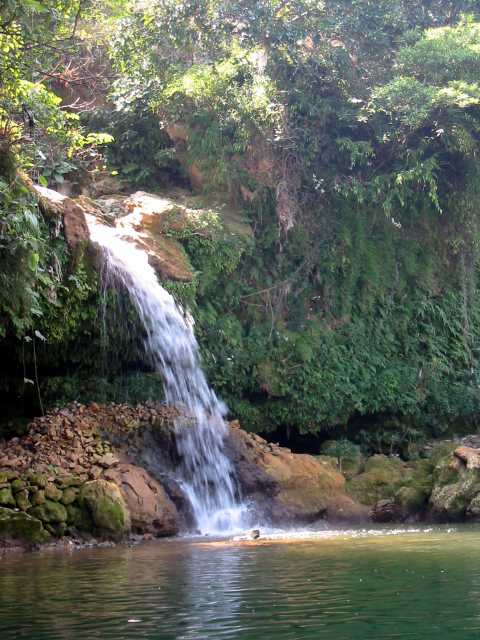
For the last day and a half the karsks had gotten shorter and disappeared from the side of the river. I wondered if we had made it past all the scenic areas of the Li River until I remembered those karsks looming over me at Yangshuo. So I knew the scenery was going to improve again soon. In the mean time there were still beautiful stands of bamboo along the river and the occasional waterfall to see.
We stumbled into another big rip current at the bottom of a drop in the river and I figured out what was causing them! When the tour boats go back up the river, they have to work hard to go up the stretches of the river where the water drops from one pool to the next. These drops are not very steep and probably still count as Class I water. But you can hear the motors in the boats laboring and see the boats slow down. Tons of water roars out the tunnel in the back of the boat that encloses the propeller for working in shallow water. It occurred to me that while they are doing this, the tour boats make a big difference in the speed of the water! The drop becomes a rapid and at the bottom it is going fast enough to whip up the standing waves that are so much fun to play in!
This rip current at the bottom of the drop continues for a few minutes after the tour boat makes it to the next pool. In the afternoon dozens of these tour boats go up-river so sometimes the fun never stops! By ducking behind a ferry as it started up a drop, Penny and I found some meter high waves to play in. I went through this spot two more times between ferries, getting honked at by one captain who thought I cut it too close!
When we arrived in Yangshuo there was a lot of boat traffic. We had to dodge them as they backed in and out of dock. We thought they cut it a little close but didn’t have a horn to honk with! Besides all the huge tour boats that had been taking people sight seeing down the river, there were huge numbers of smaller older but similar boats. I suspect that these are the previous generation of tour boats, who’s crews can no longer compete with the larger boats. If I was doing this trip over again, I would try to hire one of these boats. Instead of staying in five star hotels, I would meet the boat every evening and “camp” under a mosquito net on the roof. Instead of going to “safe” restaurants, I would eat with the crew from the galley on the back of the boat.